About Gaswan

Soloist

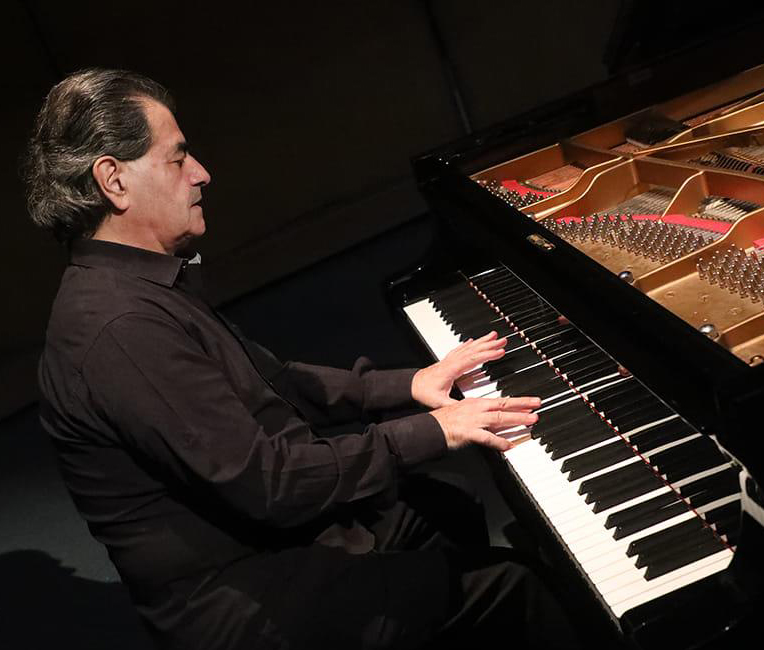
Gaswan Zerikly has released five solo performance CDs featuring works by composers such as Franz Liszt (including the B Minor Sonata), Beethoven (the Last Sonata, the Hammerklavier Sonata, and other Sonatas), Scarlatti, Haydn, Mozart, and Balakirev. His repertoire includes works by German, French, Spanish, and Russian composers.

Gaswan has also focused on performing piano concertos with orchestras, featuring compositions by Haydn, Mozart, Schumann, Mendelssohn, Grieg, Beethoven (five concertos), Brahms, Tchaikovsky, Rachmaninoff, Shostakovich, and Prokofiev. Additionally, he has performed as a soloist in twenty-five countries and has served as a member of international jury committees in four countries. In 2024 he has been invited to Saudi Arabia to appear on a television program about classical music.
Chamber Musician

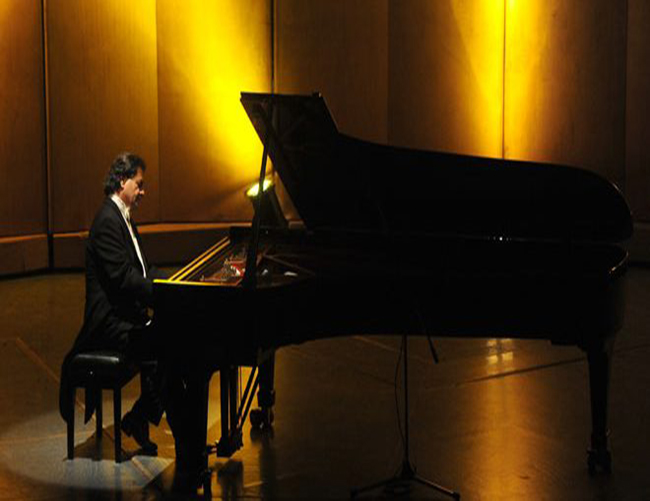
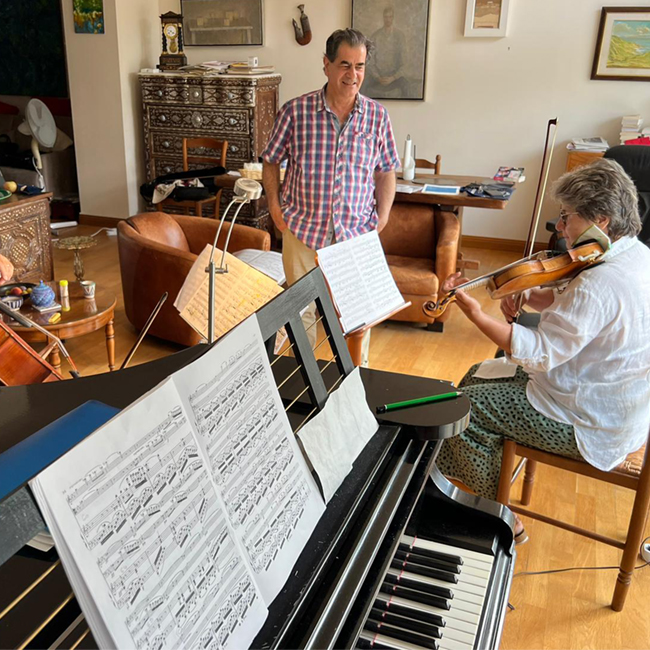
Gaswan Zerikly has always had a deep interest in piano chamber music, starting from his early musical career. He initially focused on string instruments, particularly the violin, and later expanded his expertise through university studies to include other instruments and collaborating with classical singers.

Gaswan has a notable recording featuring the violin (played by Ashraf al-Kateb), which includes works by Arab classical composers from Morocco, Sudan, Egypt, Lebanon and Syria produced in St. Petersburg, and a recording of sonatas for violin and piano.

Additionally, he has recorded modern European classical cello music, with the German composer and cellist Wilhelm Schulz.

Lately, Zerikly has been actively involved in conducting piano chamber music workshops, particularly in Germany and France.

Professor

Gaswan Zerikly began teaching when he was a student at the Arab Institute of Music in Damascus, helping to supervise younger students. Teaching has been a constant in Gaswan Zerikly's life, as he has always sought to pass on his stage experience to others, especially university students.

Gaswan's journey in higher education began in Berlin in 1976 as a professor's assistant, then continued in Moscow as a Diplom assistant professor, followed by roles as a senior assistant and lecturer in Weimar, then as a lecturer in Osnabrück, a chair professor in Damascus, and finally a senior professor at the Cairo Academy of Arts/Conservatory in 2003. Gaswan Zerikly has continued to teach solo piano and chamber music to this day, after earlier assuming leadership positions (head of the piano department and vice director of the Higher Institute of Music in Damascus) and founding his own school, Musik Akademie Weimar, in Germany.

Composer

Gaswan Zerikly has been exploring Arabic music composition, particularly focusing on lyrics, since the mid-seventies. Over the past fifty years, he has been searching for a musical style that utilizes classical European musical techniques to create authentic modern classical Arabic music, connected to its local and national identity as well as the classical Arabic language.

His work in this field is partly documented on two laser discs, with the majority composed for television, theater, and cinema. He primarily focuses on artistic songs (Lieder) and purely instrumental music. While his main emphasis is on classical Arabic music, he has also composed lyrical music in the local spoken Arabic dialect. Gaswan also aspires to create successful popular songs, reflecting the Syrian people’s desire for a better, more beautiful life and a dignified future.

Writer

Gaswan Zerikly wrote three books in Arabic expressing his thoughts on the importance of establishing a foundation for music education in his homeland, Syria.

The first book is aimed at young people and discusses the origins of music, its role in education, as well as its current and future state in Syria.

The third book focuses on children and aims to create a two-year preparatory music school with a specific Syrian curriculum. It emphasizes Arab cultural identity and European classical music, as well as music from around the world.

Gaswan published a selection of previously written articles on music and musicians between the two books, which formed the second aspect of his work in academic teaching of piano playing.

Translator

The works that Gaswan Zerikly translated from German - being a licensed teacher of German himself - into Arabic were the product of his own personal literary interest on the one hand and a desire to pass on to fellow speakers of Arabic the books that particularly influenced him on the other hand.

While the first two books he translated, On Musical Aesthetics (by Eduard Hanselk, Wagner's arch enemy and Brahms fan, and friend) and Music History were an expression of his passion for music, the other four books covered various themes: a novel by José Luis Sampedro, a study about men and women by Barbara and Allan Pease, a collection of stories by Stefan Zweig and a satire entitled “How to Become a German” by Adam Fletcher.

The first two books were translated with the aim of enhancing academic music education in Syria. The other four books represented Gaswan’s general cultural interests as well as influences from his life in Germany, which started in 1972.